Custom Leggings Manufacturing: A Development Guide for Apparel Brands
Leggings may look simple on a line sheet, yet they are one of the most sensitive garments to develop. A small shift in fabric recovery, waistband construction, seam placement, or grading can change how the garment feels, stays in place, and performs across sizes. For a new or growing brand, a clear development process turns a visual idea into a leggings specification a factory can sample and produce consistently.
This guide explains the decisions worth settling before bulk production. It is written for apparel buyers and product teams that need to align design intent, fit expectations, materials, and approvals with a custom leggings manufacturer.
Start with the role leggings play in your collection
Before choosing a fabric or silhouette, define the wearer and use case. Everyday leggings, studio leggings, training tights, fashion leggings, and layering pieces may share a category, but they require different priorities. A training style may call for reliable stretch recovery and a secure waistband; a fashion-led style may focus more on surface finish, opacity, or a distinctive panel design.
Write a short product brief that answers practical questions: Who will wear the style? What activities should it support? Is the desired fit second-skin, supportive, relaxed, or shaping? Will the garment be ankle length, cropped, flared, or stirrup? Will it be sold as a standalone bottom or paired with a matching top? These answers give every later decision a useful reference point.
Choose fabric for movement, recovery, and intended coverage
Leggings fabrics are often selected for stretch, but stretch alone is not enough. The material should be evaluated for hand feel, weight, recovery after extension, surface appearance, and how it behaves when the wearer bends or squats. A fabric can feel comfortable on a hanger yet become too sheer under stretch, lose shape after wear, or show uneven color when seams are tensioned.
Ask to compare candidate fabrics in the intended color, especially for light shades and high-stretch constructions. Consider the fiber blend and the direction of stretch, then decide whether the product needs a brushed, smooth, matte, or subtle sheen surface. If the garment may be used for training, also discuss moisture handling and the finish requirements that matter to the brand. The broader principles in this fabric selection guide for private-label clothing can help turn those preferences into questions for suppliers.
Be precise about what the sample is expected to demonstrate. Rather than asking whether the fabric is “good quality,” record the properties the team will review: coverage under stretch, recovery after wear simulation, pilling appearance, color consistency, and comfort against skin. That creates a more useful approval standard for both the brand and factory.
Build the silhouette around fit and movement
A leggings block needs more than a waist, hip, inseam, and hem measurement. Rise shape, front-to-back balance, thigh and calf circumference, ankle opening, and the curve of the gusset all affect comfort and appearance. A flattering fit on one body shape can pull at the crotch, twist at the leg, or slip at the waist on another if the pattern and grade are not reviewed as a system.
Define the intended fit in words as well as measurements. For example, state whether the waistband should sit at the natural waist or below it, whether the leg should feel compressive or easy, and where the hem should land. A clear garment measurement spec sheet gives the factory measurable targets and establishes which points will be checked during sampling and production.
Plan the waistband deliberately
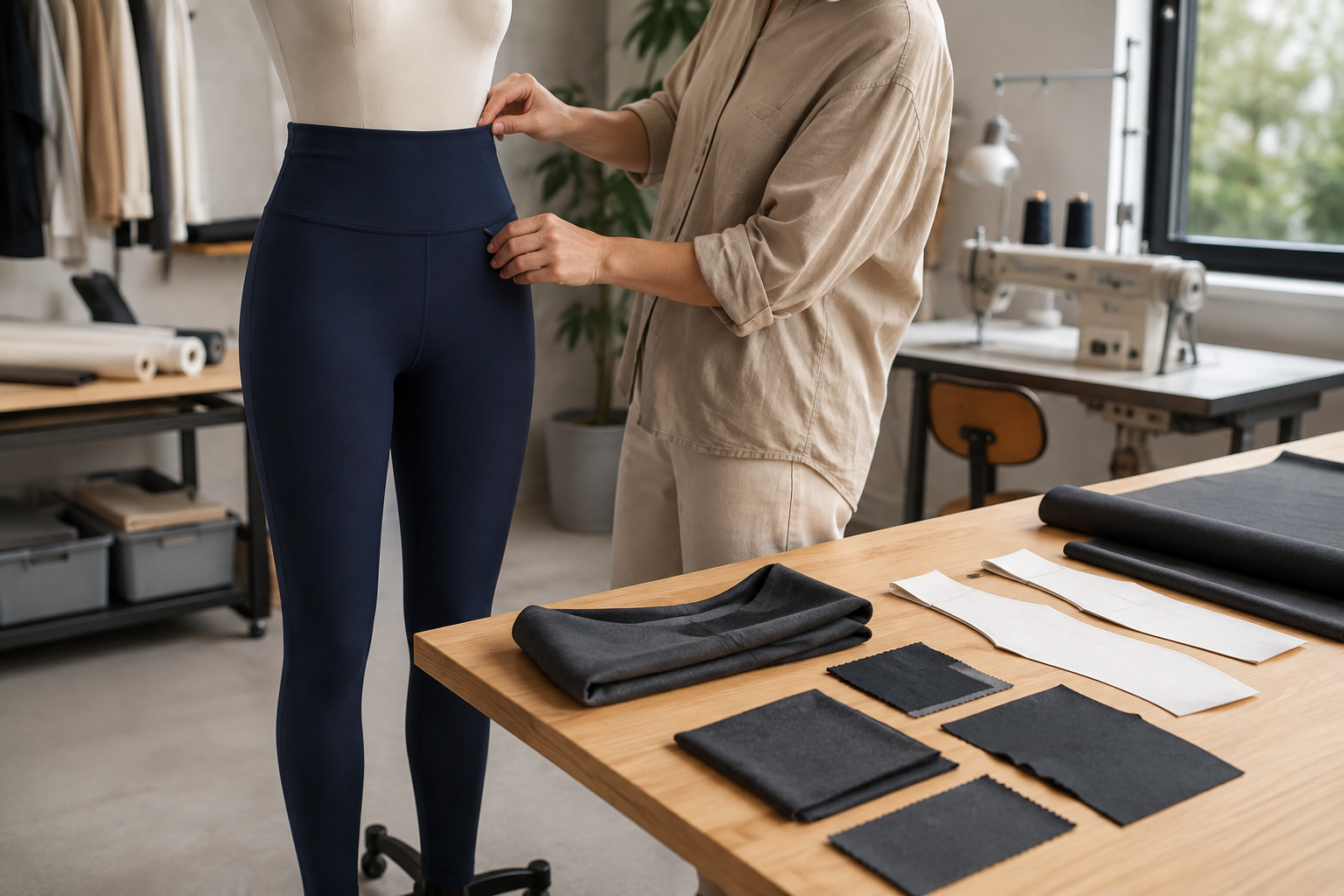
The waistband is a functional component, not a decorative afterthought. Its height, width, lining, elastic use, seam construction, and tension influence whether the leggings stay in position through movement. A folded waistband may offer a cleaner appearance, while a separate waistband can support color blocking or a shaped design. Either route needs an approved finish at the top edge and a clear expectation for stretch and recovery.
If the style includes a pocket, drawstring, bonded edge, or internal elastic, show it in the technical documentation and identify its exact location. Avoid assuming these details will be interpreted from a mood board. They should be part of the construction notes and sample review.
Use gussets and seams to support the use case
A gusset can improve mobility and reduce stress where multiple seams meet, but its shape and placement should be purposeful. A simple triangular gusset, a longer diamond gusset, and a curved panel can each produce a different fit and construction result. The same is true of side seams, inner-leg seams, and contour panels. Specify which seams are functional, which are visual, and how each should be finished.
For close-fitting garments, seam comfort matters. Review seam allowance behavior, thread appearance, and potential abrasion points on the body. If a design uses contrast panels or coverstitch details, confirm that they lie smoothly rather than distorting the fabric when stretched.
Make the tech pack production-ready
A strong tech pack connects the creative concept to repeatable manufacturing instructions. Include front and back flats, all panel and seam lines, measurement points, graded size range, bill of materials, color references, artwork placement, label requirements, and packaging instructions. Detail the waistband, gusset, hems, pockets, and any print or decoration separately when they cannot be understood from the main drawing.
It also helps to state the sample purpose: development sample, fit sample, size-set sample, pre-production sample, or another agreed stage. This prevents a team from treating an early construction sample as final approval. Use the structure in this apparel tech pack guide to check that the file gives a manufacturer one current source of truth.
Review samples in a repeatable order
Do not limit the review to a tabletop inspection. Put the sample on an appropriate fit model and observe it standing, sitting, walking, bending, and moving through the activities the product is designed for. Check waistband stability, crotch comfort, seam tension, leg twisting, opacity under stretch, hem behavior, and whether panel lines sit where the design intends.
Capture feedback in one consolidated document. Each comment should identify the location, desired change, and reference measurement or photo where useful. Statements such as “make it better” create avoidable interpretation. A focused fit-sample feedback process helps product teams translate wear-test observations into practical instructions.
Check grading before bulk production
A base-size sample does not prove that the entire size range will fit as intended. Review key graded points, including waist circumference, hip, rise, thigh, inseam, calf, and hem. Consider how the garment’s stretch affects the perceived difference between sizes. The goal is not simply to increase every point by a fixed amount; it is to maintain the intended proportion and wearing ease across the range.
Set clear approvals for trims, color, and bulk execution
Before bulk production, keep approved references for the fabric, color, elastic or drawcord if used, labels, artwork, and packaging. For printed leggings, confirm repeat scale, placement, and how the artwork meets seams. For color-blocked styles, confirm the color boundaries and panel alignment. A final pre-production review should match the latest approved specifications rather than an earlier sample version.
Document what happens if an approved input must change. Fabric availability, color variation, or trim substitutions should be raised for brand review rather than quietly incorporated into production. This approval discipline protects the product intent and makes reorders easier to manage later.
FAQ: Custom leggings manufacturing
What should a brand provide before requesting a leggings sample?
Provide a clear design brief, technical flats, target size range, measurement specification, fabric direction, color references, construction details, branding files, and notes on how the leggings should fit and be used. The more decision-ready the package is, the easier it is to evaluate the first sample.
How can brands assess opacity in leggings?
Review the actual sample in the intended color while it is stretched during relevant movement. Check it under consistent lighting and document the standard the team expects for coverage. Fabric weight and construction, color, fit tension, and size grading can all influence the result.
Why does waistband construction need separate review?
The waistband affects comfort, stability, and silhouette. Its dimensions and stretch behavior may be different from the main leg fabric, so reviewing it separately helps identify rolling, digging, slipping, or uneven tension before bulk production.
Move from concept to a confident production brief
Successful custom leggings manufacturing comes from clear decisions, not assumptions. Define the product’s use case, test fabric behavior, document fit and construction, and make sample feedback specific enough to act on. When the product file and approvals are aligned, the factory can focus on executing the intended garment consistently.
Planning a leggings program for your brand? Contact Huilin Fashion to discuss your product brief, sample requirements, and next development steps.