Private Label vs. Custom Clothing Manufacturing: Which Path Fits Your Brand?
Choosing how to make your first collection is one of the most consequential sourcing decisions a fashion brand makes. Private label and custom clothing manufacturing can both lead to a polished product, but they start from very different levels of design control. The right route depends on what is already defined, what needs to be distinctive, and how much development work your team can manage before bulk production.
This guide explains the practical difference between private label and custom clothing manufacturing for brands buying from overseas suppliers. It also shows how to brief a manufacturer clearly, compare options beyond the initial quote, and move from a promising concept to an order that can be produced consistently.
Private label and custom manufacturing are not interchangeable
In a private-label project, a supplier begins with an existing or established garment base. Your brand may select available styles, fabrics, colors, sizes, labels, packaging, or certain approved modifications. The core product is already familiar to the supplier, so the development conversation can be relatively focused.
Custom clothing manufacturing begins with your product specification. You may supply sketches, reference garments, a tech pack, measurement chart, construction details, fabric requirements, artwork, and packaging direction. The factory translates that information into patterns, samples, approvals, and eventually bulk production. A custom garment can still use common materials or techniques; what makes it custom is that the product is developed to your specification rather than selected from a ready base.
Neither option is automatically better. Private label can be a sensible way to test a category or launch a capsule with a defined look. Custom production is often the stronger choice when the fit, silhouette, fabric hand feel, construction, or brand story must be clearly different from standard offerings.
Start with the customer promise, not the manufacturing label
Before asking a supplier whether they offer private label or custom production, define what the customer should notice. Write a short product promise: perhaps a heavyweight everyday tee with a particular drape, a women’s active layer that must stay comfortable through movement, or a hoodie whose paneling supports a recognizable visual identity. Then separate the non-negotiables from preferences.
- Non-negotiables: target wearer, intended use, key fit points, fabric performance, required construction, compliance needs, and branding elements.
- Preferences: optional colorways, alternative trims, secondary design details, and launch ideas that can change after sampling.
- Evidence: reference images, a marked-up garment, fabric swatches, measurement targets, and examples of the finish you are trying to achieve.
This exercise prevents a common sourcing problem: calling a product “custom” when the team really needs a dependable blank with brand labels, or choosing a stock style when the product’s value depends on a different fit or material. It also gives potential manufacturers a clearer basis for explaining what they can develop.
When private label is a practical fit
Private label tends to work well when speed of assortment building and controlled complexity matter more than reinventing the garment. A brand may have a strong point of view in styling, merchandising, photography, community, or packaging while using proven apparel bases as a starting point.
Use it when the base garment already supports your concept
Ask to see the actual base garment, not only a catalogue image. Check the fabric composition, weight, stretch, dimensions, stitches, seams, color options, and grading. Consider how it looks after laundering and how your chosen decoration or label treatment will behave. If the basic silhouette, hand feel, and finish already align with your intended customer experience, private label can reduce unnecessary development.
Clarify what can and cannot be changed
“Private label” does not describe one fixed service level. One supplier may only add a neck label and hangtag; another may offer selected fabric colors, print placement, pockets, or trim substitutions. Request a written list of included customization and a separate list of changes that require a new pattern, new material development, or additional sampling. This protects the project from quietly moving into a custom-development workflow without an agreed scope.
Keep brand execution intentional
Even on an existing base, branding deserves a specification. Define the label type and position, size-label treatment, artwork files, packaging, folding instructions, and any care or country-of-origin information your market requires. For a detailed checklist of these elements, see this guide to private-label clothing labels and packaging.
When custom clothing manufacturing is worth the development effort
Custom production is usually appropriate when the garment itself is the product story. That may mean a proprietary silhouette, a carefully controlled fit block, performance requirements, unusual panel construction, a specific fabric development, or a design system that must be consistent across a collection.
Your specification needs enough detail to be sampled
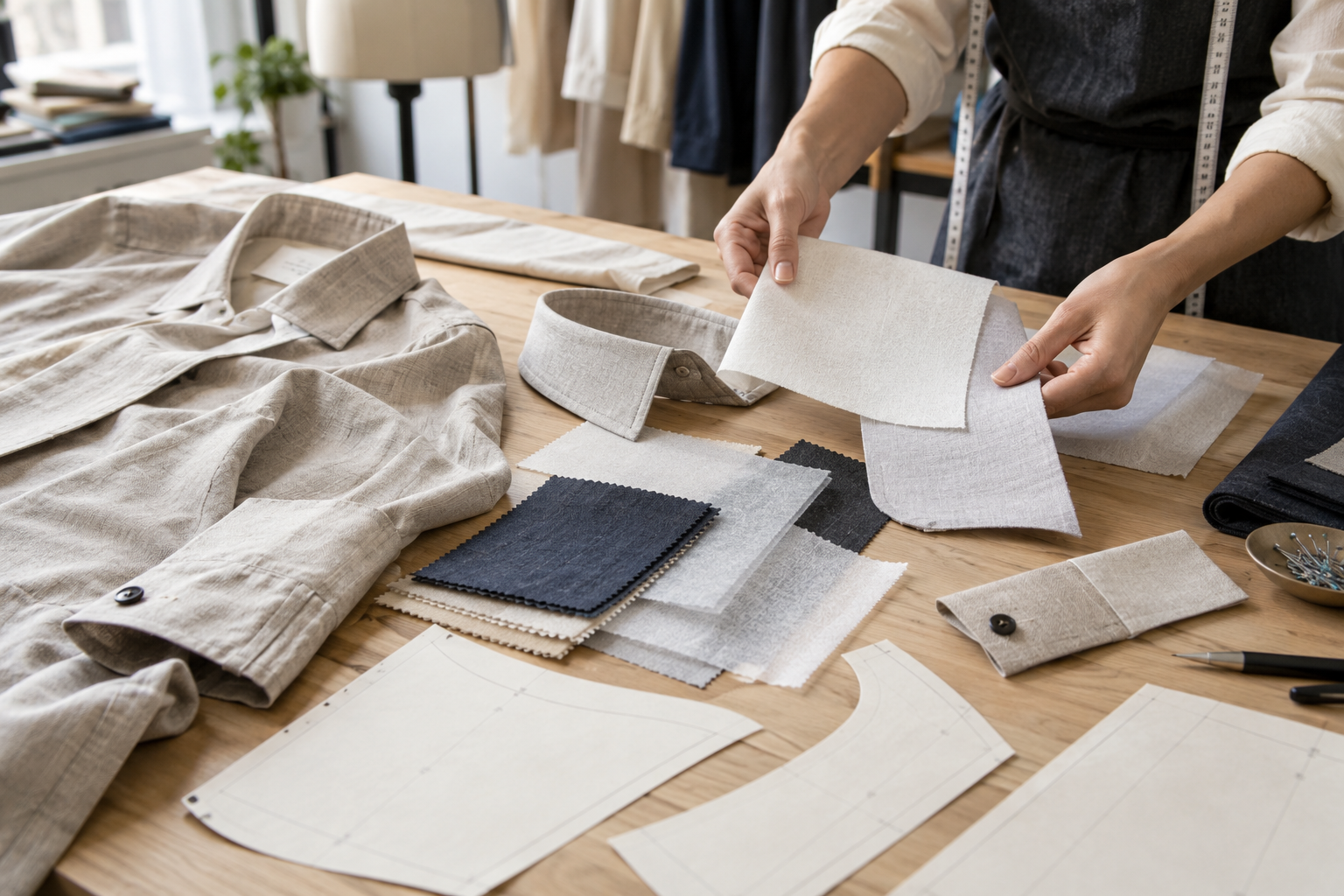
A factory cannot reliably turn an inspiration board into repeatable bulk production without decisions. A production-ready brief should identify the garment type, target fit, measurements, tolerances where important, fabric and trim requirements, color direction, construction notes, artwork, labels, and packing. A well-structured apparel tech pack provides one place for these instructions, while a bill of materials makes the components and quantities easier to track.
Sampling is a decision-making stage
Sampling is not only a proof that the garment can be sewn. It is where you test whether the pattern, fabric, construction, trims, and finishing work together. Review a sample against the same specification that will guide production. Record feedback by location and desired change rather than relying on broad comments such as “make it better.” A disciplined approach to fit sample feedback helps keep the next round focused.
Expect more choices, then manage them deliberately
Custom work creates more decision points, but that is its value. Treat each approval as a controlled handoff: fabric and color, trim and artwork, measurements and pattern, sample and construction, then final production instructions. Confirm the approved version in writing and make sure the supplier has the latest files. A clear approval trail matters more than the number of emails exchanged.
Compare the two paths across five buying questions
- Design ownership: Do you need a distinctive product architecture, or can a proven base express the brand effectively?
- Development readiness: Can your team provide complete specifications and review samples promptly? If not, simplify the product or prepare the information before requesting production.
- Material requirements: Is an available fabric suitable, or is a particular composition, weight, finish, or performance characteristic essential?
- Order strategy: Consider quantities by color and size, not merely the total order. Material, color, decoration, and construction choices may affect how a supplier plans an order.
- Quality risk: Where could variation change the customer experience? For custom products, document those points early; for private label, inspect whether the base already meets the standard you intend to sell.
Do not reduce the decision to a headline price. A lower-cost base that does not match your brand can create expensive compromises later. Conversely, adding bespoke elements without a strong customer reason can consume time and attention that would be better spent improving fit, fabric, or launch execution.
A straightforward manufacturer conversation
Give each prospective supplier the same concise project summary so you can compare their answers. State whether you are exploring a ready base, a custom design, or a hybrid. Include the product category, intended market, target quantities by style and color, fabric direction, decoration or branding requirements, technical files available, and the decisions you still need help making.
Then ask practical questions: Which parts of this request match an existing capability? Which parts need development? What sample and approval sequence would they recommend? What information is missing before they can assess feasibility? How will they identify the approved materials and construction during bulk production? The goal is not to force a premature promise; it is to understand the path from brief to repeatable garment.
For small or early collections, it also helps to discuss the production plan as a whole. This low-MOQ apparel production planning guide explains why assortment choices should be considered together with sourcing requirements.
Hybrid projects can be the right middle ground
Many successful launches are neither purely private label nor fully bespoke. A brand might start from a supplier’s familiar body block while specifying a different fabric, color, label program, print placement, or selected construction details. This can be useful when the basic fit is accepted but the customer-facing expression needs to be more specific.
The important point is to name the changes precisely. A supplier should be able to distinguish between an existing feature, an approved option, and a new development request. That clarity lets both sides plan samples, material sourcing, and approvals without assuming that a reference image communicates every detail.
FAQ
Is private label clothing the same as wholesale?
Not always. Wholesale commonly refers to buying finished goods as offered. Private label usually adds your brand identity or selected customization to an existing product base. The exact scope depends on the supplier, so confirm it in writing.
Do I need a tech pack for private label?
You may not need a full technical package when selecting an unchanged base style, but you still need clear instructions for branding, decoration, colors, sizes, packaging, and any approved modifications. If changes affect the garment’s pattern or construction, a more complete specification becomes valuable.
Can a custom design use standard fabrics and trims?
Yes. Custom manufacturing does not require inventing every component. You can combine available materials and trims with a custom pattern, fit, construction, or branding program. What matters is documenting the selected items and approvals clearly.
What should I approve before bulk production?
Approve the relevant sample, measurements and fit, fabric and color, trims, artwork placement, labels, packaging, and the current production instructions. Confirm any changes made after the sample review so the final specification is unambiguous.
Choose the path that supports a repeatable product
Private label can be an efficient route when a tested garment base genuinely fits your offer. Custom clothing manufacturing is the better route when your differentiation lives in the garment’s fit, fabric, construction, or design language. In either case, the strongest results come from a focused brief, realistic sample review, and documented approvals.
If you are preparing a new apparel collection, contact Huilin Fashion with your product concept, available files, and the decisions you need to make. A clear initial conversation can help determine whether a private-label base, a custom-development route, or a defined hybrid approach best fits the collection.