Dye sublimation printing is a digital process that uses heat to turn dye-based ink into gas, allowing the color to bond with polyester fibers. The result is a smooth, breathable print that works especially well for all-over apparel designs, sportswear, and other polyester fabric products.
For clothing manufacturers and apparel brands, successful sublimation printing depends on more than the artwork. The fabric composition, sublimation ink, transfer paper, printer settings, heat, pressure, and color management all affect the final product. This guide explains the sublimation process, paper selection, production controls, and quality checks so teams can choose the right materials and create consistent custom apparel.
What Is Dye Sublimation Printing in Custom Garment Manufacturing?
Direct Answer: Dye sublimation is a digital textile printing process that transfers disperse dye from coated paper into polyester fabric. During heat pressing, the dye changes from a solid to a gas and diffuses into the polyester fibers, where it becomes part of the material rather than forming a thick surface layer. The method works best on white or light-colored polyester; standard sublimation ink cannot produce opaque white ink. Results depend on the fabric, dye, paper, heat, pressure, dwell time, and printer profile.
[Digital Artwork] ➔ [Mirror Design] ➔ [Print onto Transfer Paper]
➔ [Heat Press: 190°C–205°C] ➔ [Dye Gas Enters Polyester Fibers]
➔ [Cool, Inspect, Cut, and Assemble]
In commercial garment production, a printer applies the mirrored design to transfer paper with sublimation ink. A calendar or flat heat press then applies controlled heat and pressure to move the dye into a suitable polyester substrate. Industrial print platforms, including systems built around Kyocera or Epson i3200 printheads, may be used, but performance depends on the complete printer, ink, paper, profile, and press combination. Factories should confirm settings with equipment and material suppliers instead of treating one temperature as universal.
- Hand Feel: Because the dye enters the fiber, the fabric can retain its softness, drape, and breathability. The print does not add the raised surface layer associated with some screen-printing inks.
- Durability: A properly calibrated sublimation process resists cracking and peeling because the color is embedded in the polyester. Fading can still occur with unsuitable ink, poor profiles, excessive heat, or harsh care, so factories should verify performance with wash testing.
- Performance: Sublimation is well-suited to sportswear, yoga leggings, cycling jerseys, and other technical apparel because it preserves the fabric’s moisture-management surface. Unlike screen printing, direct-to-garment printing, or heat-transfer vinyl, it supports efficient all-over design placement without relying on a heavy surface coating.
Key Factors That Dictate Sublimation Print Vibrancy and Durability
Direct Answer: Consistent sublimation color and durability depend on the fabric’s polyester content, a calibrated ink and color profile, and a balanced heat-transfer cycle. A polyester content of at least 85% is a practical starting point for strong color density, but the correct result depends on the material, dye system, printer, paper, press, pressure, speed, and dwell time. Temperature should be treated as a supplier- and equipment-approved starting range rather than a universal factory standard.
When evaluating a sublimation production line, an apparel factory should monitor four connected variables. The printer, sublimation ink, transfer paper, and textile must work as one system. Temperature controls dye gasification, while pressure and dwell time determine how evenly the transfer reaches the fabric. Press speed also affects exposure: a faster cycle may require a different temperature or pressure balance. Teams should validate every product and material combination with a test image or color strip before approving a production run. Spectrophotometer readings, wash testing, and fabric-shrinkage checks provide more reliable evidence than visual inspection alone.
| Production Variable | Optimal Factory Standard | Quality Impact |
| Fabric Polymer Ratio | ≥ 85% polyester for a strong starting point; test blends separately. | Higher polyester content generally improves dye transfer and color density, but does not guarantee a deeper black on every material. |
| Transfer Temperature | 195°C–205°C (383°F–401°F), subject to equipment and supplier specifications. | Supports dye gasification without unnecessarily damaging or shrinking synthetic fibers. |
| Dwell Time | Approximately 30–55 seconds for a continuous calendar press; confirm with a test transfer. | Too little time can produce weak colors; too much heat exposure can cause shrinkage, distortion, or material damage. |
| Moisture Management | Workshop RH 45%–60%, with stable temperature and acclimatized paper. | Helps limit paper curl, ink offset, uneven transfer, and web-tension problems during long printing runs. |
Why Sourcing the Right Sublimation Paper Rolls Matters for Bulk Production
Direct Answer: Industrial Sublimation Paper Rolls are the temporary transfer medium for disperse dye inks. A suitable roll combines a stable coating, fast drying, controlled release, and enough dimensional stability to remain flat during the heat-transfer stage. Specifications such as coating uniformity, GSM, roll width, core size, winding tension, and compatibility with the printer and ink should be tested together rather than judged by paper weight alone.
In continuous roll-to-roll apparel printing, paper quality affects ink absorption, drying, image registration, dye release, and production waste. GSM means grams per square meter; it describes the paper’s basis weight, not the coating’s transfer performance. A lightweight sheet can work well when coating quality and web tension are controlled, while a heavier or tack-coated sheet may be better for stretch fabrics and high heat pressure. Ask the supplier for coating data, release-efficiency test results, curl limits, moisture resistance, roll dimensions, and compatibility with the complete printing process.
- Ultra-Lightweight (29gsm–38gsm): Suitable for high-speed runs with standard ink coverage when the printer and unwinder maintain stable tension. It can reduce paper use and freight weight, but the supplier should verify curl control and dye release for the intended apparel.
- Medium Weight (42gsm–62gsm): A practical option for sportswear, streetwear, polyester shirts, and general apparel. It balances ink loading, drying, handling, and heat-transfer stability, but the correct type still depends on the design, fabric construction, and printing speed.
- Heavyweight & Sticky/Tacky Rolls (80gsm–95gsm): Often selected for elastic polyester fabrics and stretch garments. A heat-activated adhesive can hold the transfer paper against the material while the press opens, reducing movement and ghosting. Test for residue, release behavior, and compatibility with the printer before approving bulk production; tacky paper is not a substitute for selecting a suitable polyester substrate.
For wide-format printing, confirm that the roll width, core, and winding tension match the equipment; do not assume a maximum format such as 3.2 m applies to every line. Before purchasing in volume, compare sample rolls using the same printer, sublimation inks, transfer temperature, heat pressure, fabric, and color profile. This controlled trial is the most reliable way to assess print quality, gas release, registration, waste, and finished-product consistency.
How Apparel Factories Evaluate a Sublimation Paper Rolls Manufacturer
Direct Answer: Garment factories should evaluate a Sublimation Paper Rolls Manufacturer through documented coating uniformity, transfer performance, web strength, packaging, traceability, and current compliance records. Request sample rolls and certificates before approving products for a long-term supply agreement.
A dependable supplier helps sublimation printers maintain repeatable color, reduce paper-related waste, and protect delivery schedules. Buyers should compare the supplier’s test method, material specifications, production capacity, and support for the intended printer, ink, polyester fabric, and other products.
- Coating and slitting consistency: Ask for coating-thickness specifications, batch test results, slitting tolerances, and lot traceability. A stated tolerance such as ±1.5% must be supported by a defined measurement method; uniform coating helps produce consistent prints across repeat orders.
- Transfer performance and compatibility: Request sample rolls for the exact sublimation printer, ink, design coverage, and fabric type. Do not accept a “≥95%” transfer-yield claim without test conditions. Compare high-quality prints, color density, drying, gas release, registration, and waste against the buyer’s current paper. The same checks apply to products such as apparel, mouse pads, and other polyester items.
- Safety and environmental documentation: Request current certificates and test reports for Oeko-Tex Standard 100, REACH, or RoHS, where applicable. Distinguish certified status from a supplier’s general compliance statement, and ask how formaldehyde, heavy metals, and APEOs are controlled. Documentation should identify the factory, product, testing date, and applicable material.
- Strength, packaging, and delivery reliability: Confirm tensile-web data, core dimensions, winding tension, moisture-barrier packaging, and storage instructions. Reinforced PE wrapping may help protect rolls during ocean freight, but buyers should verify packaging performance in their route and climate. A supplier with stable lead times, lot traceability, and responsive technical support reduces production risk more effectively than a low unit price alone.
Before scaling production, use the same printing methods, printer profile, heat, pressure, and fabric planned for the final order. Keep the approved sample, test report, and lot specifications as a reference for future products. This process helps apparel teams control cost, limit reprints, and maintain consistent quality across global deliveries.
Quality Control SOP: Preventing Ghosting, Bleeding, and Color Shift
Direct Answer: A reliable sublimation quality-control SOP combines fabric preparation, acclimatized paper, calibrated heat, controlled pressure, and documented color checks. Pre-shrink fabric only when the textile supplier or production test requires it, and acclimatize paper for the supplier’s stated period—often 24 to 48 hours—under stable workshop conditions.
Use a test print before approving each garment or product combination. Record the substrate lot, ink lot, paper lot, printer profile, temperature, press speed, dwell time, pressure setting, humidity, and inspection results. Pressure and heat must follow the equipment and material specifications; a setting that works for one fabric may damage another. Maintain a stable environment, commonly around 20°C–25°C and 45%–60% relative humidity, then verify the result through visual inspection, color measurement, wash testing, and shrinkage checks.
| Defect | Likely Cause | Test / Corrective Action | Prevention |
| Ghosting or double image | Paper or garment movement when the press opens. | Test: Compare a taped and untaped transfer; inspect alignment. Corrective Action: Use compatible tacky paper or tape and reduce movement. | Check platen alignment, pressure balance, and material flatness. |
| Color shift, faded dyes, or uneven density | Incorrect color profile, ink, heat, dwell time, or transfer paper. | Test: Print a calibrated color chart and compare measured values. Corrective Action: Recheck the profile and heat-transfer settings; test fresh paper/ink. | Lock approved lots and inspect color before production. |
| Bleeding, banding, or pinholes | Excess ink, moisture, nozzle issues, or uneven heat. | Test: Inspect nozzles, paper moisture, and a full-width test image. Corrective Action: Correct the profile, dry the material, and service the printer. | Monitor humidity, nozzle checks, and press temperature. |
| Paper wrinkling or web tear | Humidity, poor storage, or uneven unwinder tension. | Test: Check roll edges, core alignment, and room conditions. Corrective Action: Stabilize the room near 20°C–25°C and 45%–60% RH; realign the unwinder. | Store paper sealed and acclimate it before use. |
Huilin Fashion’s Approach to Custom Sublimated Apparel & Low MOQ Production
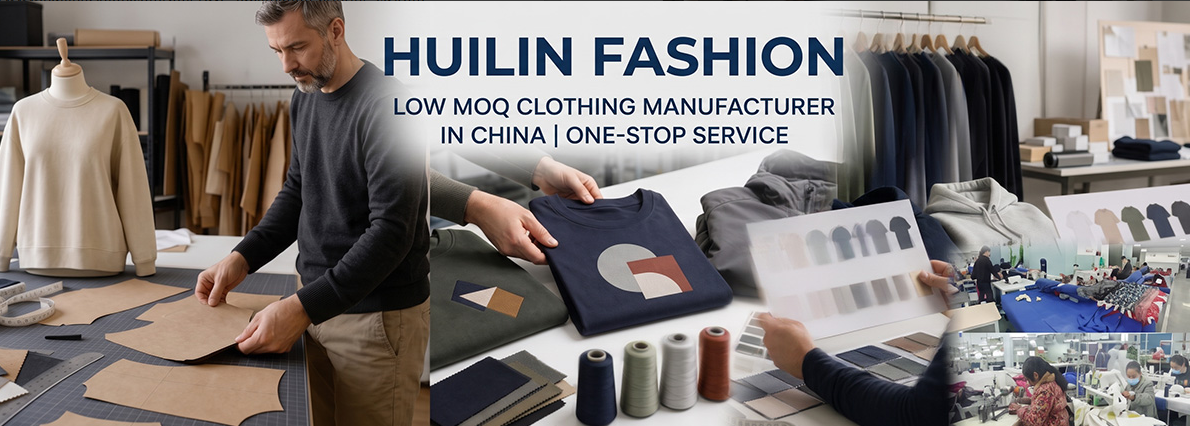
Huilin Fashion helps emerging streetwear labels, fitness brands, and corporate teams develop custom apparel with practical production support. Confirm the current MOQ, available fabric options, sample process, lead times, certifications, and quality-control procedures with the production team before placing an order.
- Low MOQ Starting at 50 Pieces: If currently available, a 50-piece starting MOQ can help new brands test a custom apparel concept, sublimated design, or colorway before committing to larger inventory. Confirm whether the MOQ applies per style, color, size range, or order.
- End-to-End OEM/ODM Services: Ask whether the supplier can manage artwork review, digital pattern grading, sample development, polyester fabric sourcing, sublimation printing, cutting, sewing, packaging, and private labeling. Confirm which services are handled in-house and which rely on partner suppliers.
- Rigorous Quality Standards: Request evidence of the factory’s quality-control system, inspection checkpoints, wash-testing process, and fabric and print tolerances. If ISO 9001 or sustainable-textile guidelines are cited, verify the current certificate, issuing body, scope, and expiration date rather than treating the claim as a guarantee.
To request a quote, provide the artwork, garment type, fabric composition, quantity, size range, target delivery date, packaging details, and branding requirements. Contact Huilin Fashion today to request a sample, confirm current capabilities, and discuss a production plan.
Frequently Asked Questions (FAQ)
Can 100% cotton garments be printed with dye sublimation?
Standard dye sublimation printing is not suitable for 100% cotton because disperse dye bonds most effectively with polyester fibers. For cotton products, consider screen printing, direct-to-garment printing, or another compatible transfer method. Always test the selected ink, fabric, and care process before approving a garment order.
What is the advantage of using sticky sublimation paper on sportswear?
Sticky, or tacky, sublimation paper uses a heat-activated coating to hold suitable polyester sportswear in place during transfer. This can reduce fabric movement when the press opens and help prevent ghosting or blurred prints, especially on stretch materials such as Lycra or spandex. Test the paper for residue, release, pressure requirements, and compatibility with the printer, ink, and fabric before using it for bulk printing.
How does sublimation transfer paper affect overall garment costs?
Transfer paper affects total cost through its price, ink release, drying behavior, speed, waste rate, and effect on reprints. A paper advertised with 95% or higher transfer efficiency may reduce ink and material waste, but performance varies by printer, sublimation ink, color profile, heat, pressure, fabric, and design. Compare sample prints and production data rather than assuming every high-yield paper will deliver the same result. For consistent products, approve the paper together with the complete printing process.
What fabric is best for dye sublimation?
White or light-colored polyester fabric is generally the most suitable substrate because disperse dye bonds with polyester during heat transfer. Higher polyester content usually supports stronger color density, while blends may produce a softer or less saturated result. Test the exact fabric, ink, paper, and design before approving finished products.
What temperature and dwell time should I use?
A common starting range is 195°C–205°C (383°F–401°F) for about 30–55 seconds on a continuous calendar press, but the correct settings depend on the press, speed, paper, ink, and fabric. Follow supplier specifications, run a test image, and check color, shrinkage, registration, and wash performance before full production.